Seeg is a village in the foothills of the Bavarian Alps and the first place I lived in Germany. I went there in the summer of 1991 to visit my brother, who was already a resident there, fell in the love with place and have thought of it as my second „Heimat“ ever since. Two years ago we bought a flat there and as we get older we envisage spending more time in Seeg and less time in Schönaich (the suburb of Stuttgart where we currently live).
I just spent a couple of sunny days down there, and thought I‘d write down what I got up to and how a day feels in and around Seeg. Here goes:
I wake up to the dull and pleasant clank of cowbells on the hillside opposite. I can see out of the window that the sky is clear and it‘s going to be a beautiful day. This alpine idyll is, however, quickly broken by the deafening and strangely atonal clanging of the church bells. Growing up, on Argyll Close in Horsforth, we were directly under the final approach flight path for Leeds/Bradfort airport. After a while we didn‘t hear the planes. I am hoping that the same thing will happen with the church bells. We don‘t really have grounds for complaint, as we knowingly bought a flat which is right next to St. Ulrich’s church and overlooks graveyard. On the plus side, the view beyond the graveyard is a panorama of the lakes and rolling hills of the Ostallgäu (the sub-region of Bavaria we are in).
Apologies for dwelling on the church bells, but they do merit a little more detail. In English, we talk of church bells „peeling“ which brings to mind wedding groups spilling out of the into the sunshine and throwing confetti as the bells add to the cheerful mood. The bells in Seeg are the complete opposite. „Clanging“ is the right word. There are only 3 notes, and they all seem to be in different keys. First the lower note clangs for a minute and just when you think it‘s over, the higher notes pick up. There‘s no melody just an ugly clanging which always brings to mind this silly sketch. It‘s surprising that the bells of St. Ulrich are so simple and ugly because the rococo interior of the church is over-the-top elaborate. The cowbells are lovely in comparison. They provide alpine backing music of which I am only aware when I stop and think about it.

I recover from the sonic ear-bashing, get up and go to the bakery next door (even closer than the church) for my breakfast rolls and pretzel. The Germans love fresh bread for breakfast and every village has at least one bakery. If you are lucky, then the pretzels will be an absolutely fresh batch and still be warm from the oven. I like the ritual of going to the bakery first thing in the morning. There‘s also no quicker way of exposing where you come from in Germany by asking for your roll in the „wrong“ way. The „proper“ German word for a bread roll is a „Brötchen“ (literally, a small bread). But in Bavaria, this is a „Semmel“. In Stuttgart it’s a „Weckle“ and in Hamburg a „Rundstück“. I am careful to ask for a „Semmel“ and to say „Brezen“ instead of Pretzel. I suspect they know I‘m a foreigner but I like to keep them guessing.
After a quick, classic German, breakfast of ham and cheese on bread washed down with coffee, I jump in the car and drive 20 minutes to the car park in Pfronten at the bottom of the Breitenberg mountain. As the cable-car is currently closed for it‘s spring service, my plan is to walk up the mountain and fly off with my paraglider. Paragliding was the reason I came to this corner of Germany in the first place and is still my hobby. As much as I like the convenience of a lift to carry me the 750m to the take-off area, I am happy to walk up today. It‘s a two hour slog, but I need the exercise and the scenery is particularly beautiful. The lift being closed also means that there won‘t be many other paraglider pilots up there which makes things less stressful. At this time of year, the mountain tops are still covered in snow but lower down everything is green as spring takes hold.
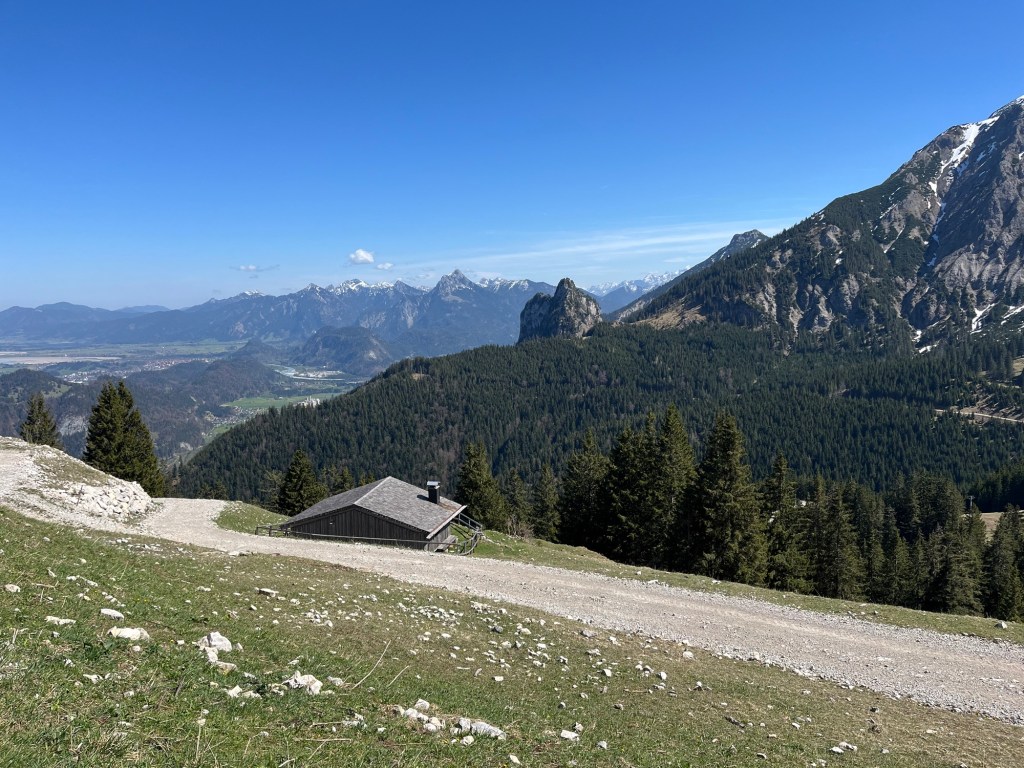
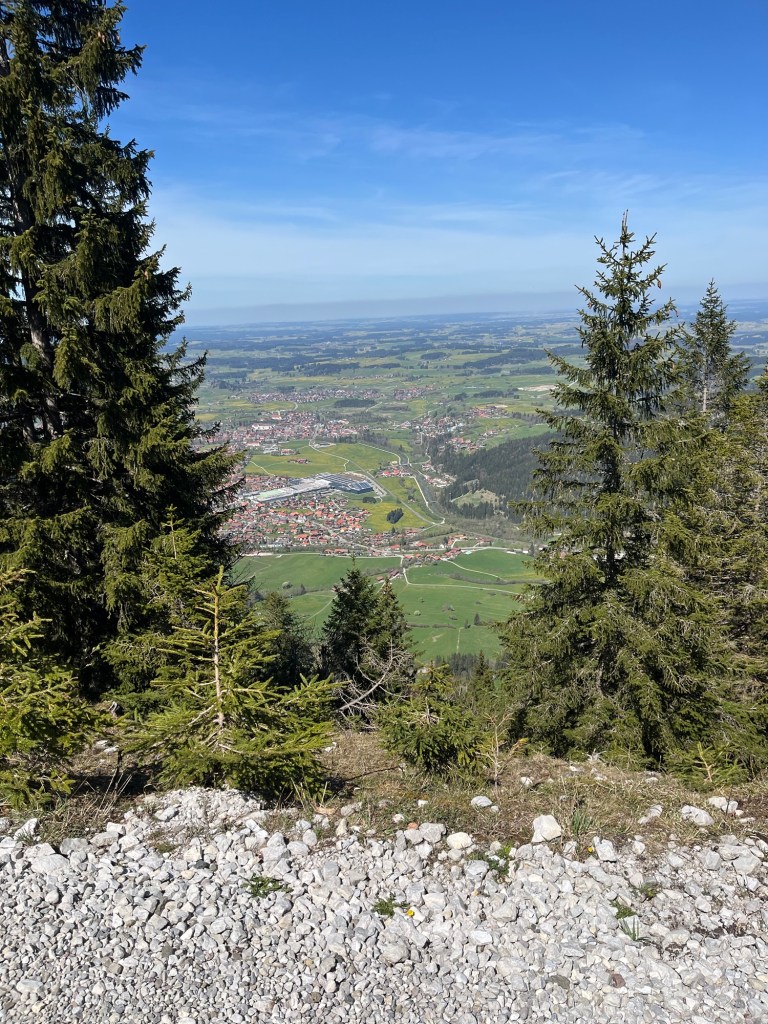
The car park at the bottom of the lift is nearly empty. There are just a couple of walkers and one very sporty looking character sporting a man-bun. As I pull up he is emerging from a VW-bus which has some surfing stickers and the „hang loose“ hand signal emblazoned on it. He is dressed in lycra trail-running gear and has a small paraglider on his back. I take an instant dislike to him, but give him a friendly „hello“ just the same. He gives me a taciturn „Servus“ in return. This greeting is favoured by Bavarians and Austrians and instantly qualifies you as a mountain person as opposed to just a tourist. I see that his van has a number plate from Füssen, so he lives locally. My number plate is from Stuttgart, so he probably has me pegged as a stupid flatlander tourist partly responsible for clogging up his mountain. I know this because, twenty five years ago, when I lived and worked in the mountains and was filled with the arrogance of youth, I considered myself a „local“. I looked down upon mere tourists with the unreasonable disdain that I detected in his eyes. On the other hand, I never had a man-bun.
After a short faff, putting on walking boots and making sure I had everything I needed in my rucksack, I set off up the mountain. I have done this walk many times before and know to take it steady. I plod steadily upwards, looking at the ground and only allowing myself to look back after every hundred steps to see how far I‘ve come. Very soon, lycra-man breezes past me. I have already unfurled my hiking sticks and they are tip-tapping on the hard path as I ascend. He has his sticks in one hand, carried by his side. I interpret this as a further micro-aggression. It‘s as if he wanted to tell me that it‘s not yet steep enough to merit the use of sticks. Of course he was probably just another dude enjoying a day in the hills and had barely noticed me.
There‘s nothing like a long walk to get you thinking. I start by wondering what‘s wrong with me. Here I am in the infinitely privileged position of being able to walk up a beautiful mountain in pristine spring weather and then fly off it. Yet my main concern is a petty mental battle with a fellow pilot, upon whom I have probably unfairly projected all sorts of faults. I must try harder in future. Still… the man-bun, the car-stickers, that lycra… Anyway, at least he was soon off in the distance and I could forget about him and dwell on the beauty of life instead.
I take my time to get up the mountain. Another pilot catches up to me and asks me some questions about the mountain. He has never flown here before and doesn’t want to make any mistakes. I like him straight away – because he makes me feel important. I give him a few tips, for which he is grateful. We chat for a while and I can see he wants to go faster but is too polite to stop the conversation and pull away. I make it easy for him and explain that this is my tempo and he is free to speed on ahead. He soon disappears over the horizon, too.
After two hours, I arrive at the grassy spot from where the paragliders launch. To my surprise, lycra-man is still sitting there. I would have expected him to have taken off ages before I finally arrived. As it happens, the wind hadn‘t been quite right so all those that raced up had just been hanging around waiting for conditions to improve. I unpack my gear, hang my sweaty t-shirt on a wooden post to dry and put on a thermal top. With my arrival, the wind suddenly switches and conditions become perfect. Very satisfying, and pure luck. Still, I secretly hope that the others, all much younger than me, are thinking that the „old-salt“ knew exactly when to arrive.
There‘s no point hanging around so I put on a warm jacket, overtrousers and my helmet. Then I clip into my harness and launch quickly. Conditions are excellent, and I am able to use thermals to climb up above the summit of the Breitenberg and enjoy the view to the South of seemingly endless Austrian peaks. I fly around for half an hour and then fly over the town of Pfronten, and finally to land.
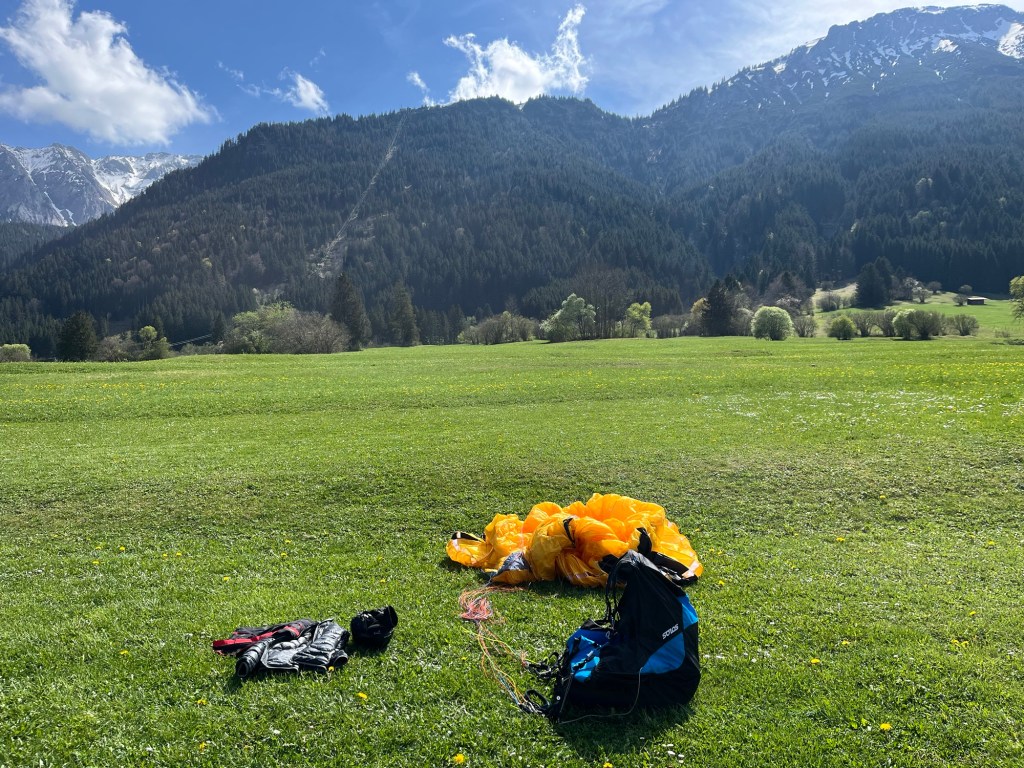
By now, it is very hot in the valley and my black thermal top is not the ideal attire. I do not want to inflict the sight of my white torso for too long on the couple sitting on the bench in the landing field, so I rummage around in my harness for my t-shirt. Oh dear. In my general feeling of smugness at having arrived at the perfect time on launch, I had forgotten to retrieve my t-shirt from the fence-post.
I pack up, sweating profusely into my thermal top, and wander back to the car. From there I drive to the Schwaltenweiher which is a small bathing lake next to Seeg. As it is off-season at the moment, the place was empty, even though the weather was still delightful. I ordered a beer and had a long chat with Heini and Renate – the couple who run the place and friends of mine for over 30 years. One beer didn‘t seem quite enough so I order another. Heini is a retired balloon-pilot and Renate a keen mountaineer. We talked about mountains, flying and some village gossip until the sun dropped behind the trees and it got too cool to sit out.
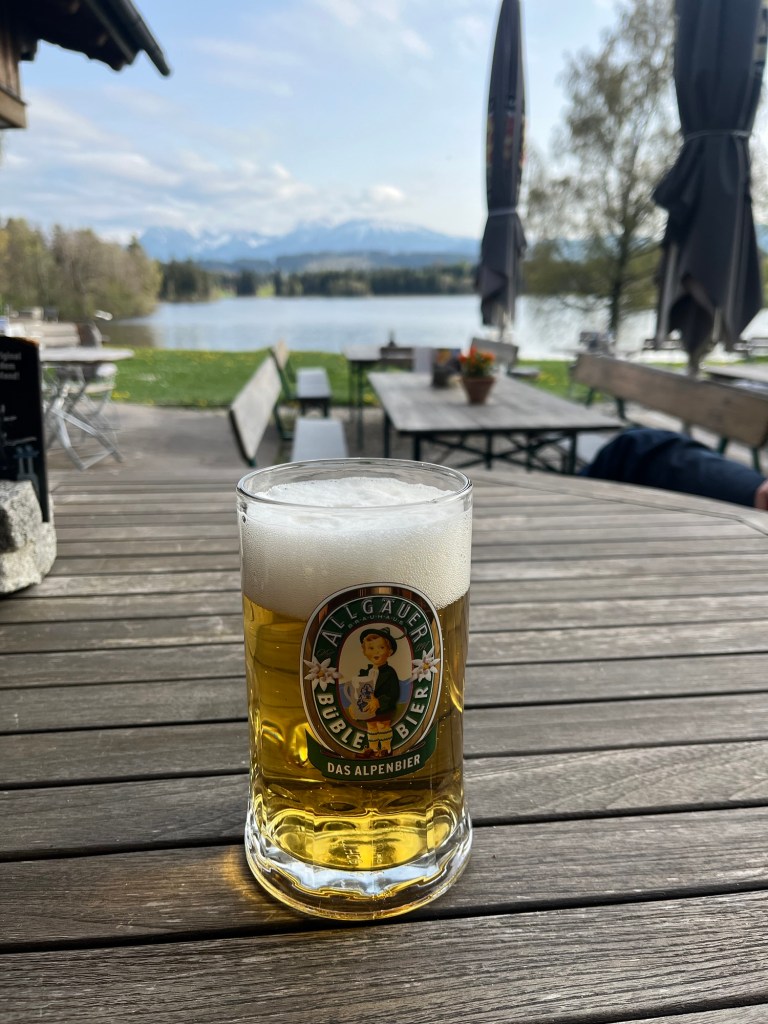
I head back to Seeg and see that the local restaurant is open but nearly empty. The owner, Andy, is also an old friend. I wander in and see that the waitress and Andy‘s wife are having their dinner at the „Stammtisch“. Eva, the waitress, jumps up and pours me a fresh beer. I sit with them as Andy pokes his head out of the kitchen and says he‘ll be out in a minute. We end up chatting until 11 about the goings-on in Seeg but also about our favourite „go-to“ subjects: books and music. Andy is great company but we‘re both tired and at 11 I wander back to the flat.
It has been a great day. I love being in Seeg. I’ve been surrounded by beauty and spent time in the company of old friends. Still, as I drift off, I can‘t help thinking of that bloody man-bun and wondering whether my t-shirt is still on that fence-post.
 Living in Germany